

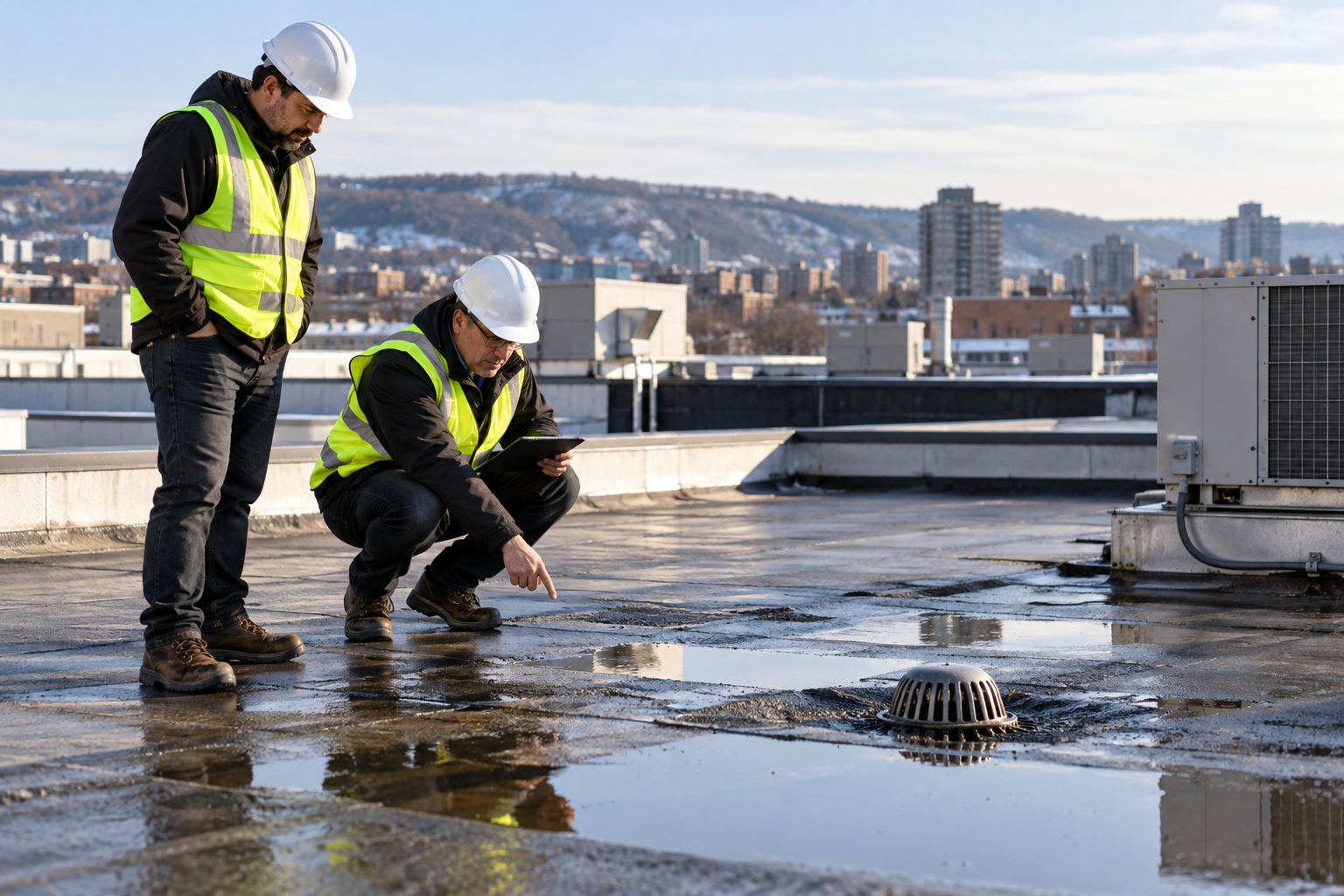
Commercial roofing systems are long-term building assets, but their service life depends on more than age alone. Installation quality, system design, drainage, maintenance, rooftop activity, weather exposure and the timing of repairs can all contribute to commercial roof problems in Hamilton.
When a problem appears, the visible symptom does not always reveal the underlying cause. A leak, for example, may originate some distance from where water becomes visible inside the building. A professional commercial roofing assessment can help identify contributing conditions before a property manager decides whether repair, maintenance, restoration or replacement is appropriate.
Understanding the cause matters because similar symptoms can result from different conditions. Identifying those conditions first can help building owners make more informed decisions about the roof and avoid treating every problem as a replacement issue.
Commercial Roof Problems Can Start Before a Leak Appears
Visible commercial roof leaks are often what bring a roofing problem to a property manager’s attention, but deterioration can begin earlier. Membrane damage, flashing issues, drainage restrictions and problems around roof penetrations may develop gradually without immediately affecting the building interior.
Water can also travel through or around roofing components before appearing inside. The location of a ceiling stain may therefore not identify the exact point where water entered the roofing system.
Routine observation and professional assessment can help identify developing conditions earlier. Changes in membrane appearance, recurring ponding water, damaged flashing or repeated issues in the same area may all justify closer investigation.
Poor Drainage and Standing Water
Commercial flat roofs rely on effective drainage to move water toward drains, scuppers and other designed outlets. When those pathways become blocked or water movement is restricted, standing water can remain on the roof longer than intended.
Debris accumulation, blocked drains, obstructed scuppers and changes to roof slope or drainage patterns can all contribute to ponding water. Building modifications may also affect how water moves across the roof, particularly when new equipment, curbs or other rooftop components are added.
Ponding water does not automatically identify the cause of commercial roof failure. However, roof drainage conditions should be investigated as part of a commercial roof inspection in Hamilton because persistent standing water may expose or worsen existing vulnerabilities.
Membrane Damage and Deterioration
A commercial roof membrane can be affected by punctures, tears, open seams, surface deterioration and other visible abnormalities. Some damage may develop gradually, while other damage can result from equipment movement, maintenance activity or concentrated foot traffic.
The significance of membrane damage depends on the roofing system and the surrounding conditions. A visible defect may be limited to one area, or it may be part of a broader issue involving seams, insulation, drainage or previous repairs.
This is why membrane appearance alone should not be used to determine whether a roof requires repair or replacement. An inspection can help establish the extent of the damage and whether moisture has affected other roofing components.
Flashing, Edges and Roof Penetrations
Commercial roofs contain many transition points where roofing materials meet other building components. These areas deserve particular attention because different materials, assemblies and building systems come together at the same location.
Common areas include HVAC curbs, vents, pipes, roof edges, parapets, flashing and other penetrations. Newly installed equipment can also introduce additional roof penetrations that must be properly integrated with the existing system.
When commercial roof leaks appear near rooftop equipment or perimeter areas, these interfaces should be included in the investigation. The objective is not to assume that flashing or a penetration is responsible, but to confirm the actual source before recommending work.
Rooftop Traffic and Mechanical Work
Commercial roofs frequently serve as access areas for HVAC systems, electrical equipment, communications equipment and other building infrastructure. As a result, they may experience considerably more foot traffic and service activity than many other roofing systems.
Repeated access can affect roofing components over time, especially when established walkways are not used or when tools and equipment are placed directly on the membrane. Mechanical projects can also introduce new curbs, supports, penetrations or changes to existing rooftop conditions.
Property managers can reduce unnecessary risk by treating roof access as part of building management. Recording who has accessed the roof, documenting equipment installations and noting when penetrations have been added can provide useful information if a problem later develops.
This is not about assigning responsibility to another trade. Multiple contractors may need legitimate roof access during normal building operations. The goal is to understand how rooftop activity may affect roofing components and to ensure that changes are considered when investigating premature roof deterioration.
Hamilton Weather and Seasonal Exposure
Commercial roofs in Hamilton are exposed to freeze-thaw cycles, snow and ice, heavy rainfall, wind and significant seasonal temperature changes. These conditions can place additional stress on roofing materials and existing vulnerable areas.
Weather should not automatically be treated as the sole cause of flat roof problems in Hamilton. In many cases, seasonal exposure may reveal or accelerate a condition that already exists, such as restricted drainage, membrane damage, deteriorated flashing or a weak transition around a roof penetration.
For this reason, significant weather events can provide an appropriate reason to observe known problem areas or investigate new symptoms.
Deferred Repairs Can Increase the Scope of the Problem
Recurring leaks or unresolved roof problems deserve investigation because conditions can change over time. A problem that initially appears limited may continue affecting roofing materials if the underlying cause remains unaddressed.
Depending on the circumstances, possible concerns can include continued membrane deterioration, moisture migration, wet insulation, interior damage or repeated repair requirements. These outcomes do not occur in every case, but they are reasons to investigate recurring problems instead of relying only on repeated short-term fixes.
A structured commercial roof maintenance approach can also help property managers monitor known conditions, drainage areas and previous repair locations over time.
Repair, Restore or Replace?
Finding a roofing problem does not automatically mean the roof needs replacement. The appropriate response depends on the actual condition of the system and the cause of the problem.
Factors that may influence the decision include roof age, system type, extent of damage, moisture conditions, repair history, overall membrane condition, insulation condition and expected remaining service life. Building plans and capital budgets may also affect how owners evaluate available options.
A localized defect may support a targeted repair in one situation, while broader deterioration may require a different approach. Restoration may also be considered for some roofing systems when conditions are appropriate.
When replacement is being evaluated, understanding the condition of the existing system can support better commercial roof replacement planning. The key is to make the decision after the roof has been assessed rather than assuming a particular solution based on one visible symptom.
How Property Managers Can Reduce Premature Roof Problems
Property managers can take practical steps to reduce avoidable roofing issues without turning roof management into a complicated process. Maintaining drainage, controlling rooftop access and documenting mechanical work can make it easier to identify changes that may affect the roofing system.
Previous repairs should also be recorded so recurring problem areas can be recognized. If the same location requires repeated attention, that history can be useful during a professional assessment.
Known defects should be addressed promptly where appropriate, and inspections may be worthwhile after significant events or major rooftop work. Commercial roofing should also be considered within longer-term property and capital planning so decisions are based on documented conditions rather than unexpected failures.
Have a Commercial Roof Problem Professionally Assessed
Commercial roof problems in Hamilton can have more than one contributing cause. Drainage, membrane condition, flashing, roof penetrations, rooftop activity, weather exposure and previous repairs may all need to be considered before deciding on the next step.
Torham Exterior Solutions can assess commercial roofing conditions and help property managers and building owners determine an appropriate course of action based on the building, roofing system and observed conditions.
Have Your Commercial Roof Assessed
If your Hamilton property is experiencing recurring leaks, drainage concerns, membrane damage or other roofing problems, Contact Torham Exterior Solutions to have the condition evaluated before deciding on repair or replacement.