

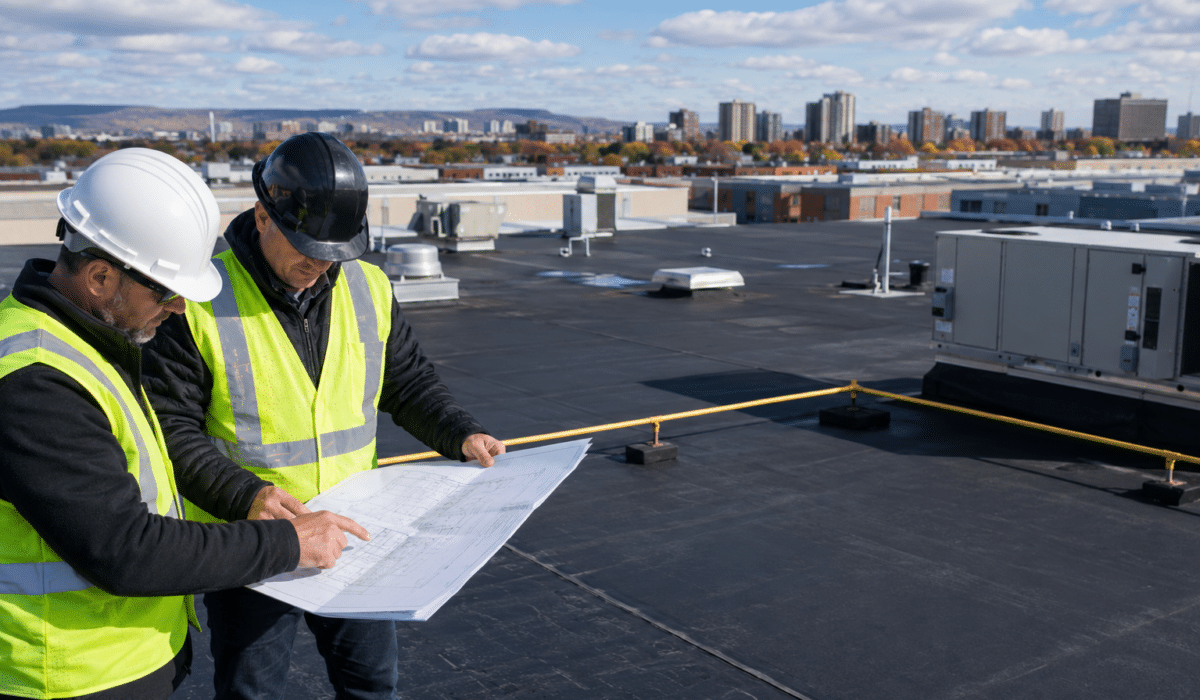
A commercial roof replacement is a significant capital project. For property owners, property managers, facility managers and asset managers in Hamilton, the process should begin well before roofing materials arrive on site. Understanding the existing roof, the needs of the building and the potential project scope can support better budgeting and planning decisions.
Commercial roof replacement planning also involves more than choosing a roofing membrane. Building operations, drainage, insulation, rooftop equipment, access and weather can all influence how a replacement project should be approached. Working with an experienced commercial roofing contractor can help decision-makers evaluate these factors before committing to a replacement plan.
When Should a Commercial Roof Be Considered for Replacement?
Repeated leaks and repairs can indicate that an existing roofing system requires a broader assessment. Other warning signs may include widespread membrane deterioration, persistent drainage problems, moisture concerns and maintenance costs that continue to increase as the roof ages.
However, roof age alone does not determine whether replacement is necessary. Two roofing systems of similar age can have very different conditions depending on installation quality, maintenance history, drainage, exposure and building use.
The decision should therefore be based on the actual condition of the roof. A professional assessment can help determine whether specific areas can continue to be repaired or whether deterioration has reached the point where restoration or replacement should be considered.
Start With a Professional Roof Assessment
Before planning a commercial roof replacement in Hamilton, decision-makers need a clear understanding of the existing roofing system. An assessment provides a starting point for establishing the condition and potential scope of the project.
The evaluation may include the roof membrane, flashing, drainage components, penetrations, insulation, previous repairs and areas where moisture may be present. Rooftop equipment and transitions between different roof areas may also require attention.
This process is important because visible surface problems do not always reveal the condition of the complete roofing assembly. The goal is to gather enough information to determine whether continued repair, restoration or replacement is the appropriate next step.
For owners planning future capital expenditures, an assessment can also help establish priorities. Knowing that a roof is approaching replacement can provide more time to coordinate budgets, building operations and other planned improvements.
Understand the Requirements of Your Commercial Building
There is no single replacement approach that applies to every commercial property. The appropriate roofing system and project plan depend partly on how the building is designed and used.
Warehouses may have large roof areas with relatively straightforward layouts but significant drainage requirements. Manufacturing facilities can include exhaust systems, mechanical equipment and numerous roof penetrations. Office and retail properties may require additional planning around employees, tenants and customers.
Institutional properties and multi-unit commercial buildings can introduce their own access and scheduling requirements. Contractors may need to coordinate work around occupied areas, entrances, deliveries or other activities that cannot simply stop during construction.
Understanding these conditions early helps ensure the commercial flat roof replacement plan reflects the building rather than treating the roof as an isolated component.
Compare Commercial Roofing System Options
Several commercial roofing systems may be considered for low-slope and flat-roof applications. Common options include TPO, EPDM and modified bitumen, along with other systems appropriate for specific buildings and project conditions.
System selection should consider factors such as the existing roof assembly, insulation requirements, drainage, rooftop equipment and installation conditions. Long-term maintenance requirements should also be part of the discussion.
Property decision-makers who want additional information about two common membrane options can review Torham’s guide to TPO vs EPDM roofing systems.
A general comparison can help with preliminary research, but the final decision should be based on the actual property. A professional roof assessment provides the building-specific information needed to evaluate which system is appropriate.
Plan Around Business Operations
Commercial roof replacement takes place on an active property, and roofing work can affect more than the roof itself. Planning around business operations is therefore an important part of project preparation.
Tenant access, employee and customer safety, material staging, equipment locations, noise and working hours may all need to be considered. Contractors also need suitable site access for workers, materials and equipment while maintaining safe movement around the property.
Rooftop mechanical equipment can create additional coordination requirements. Depending on the building, roofing work may need to be sequenced around HVAC equipment, vents, exhaust systems and other penetrations.
Weather can also affect the project schedule. A well-developed plan should account for both roofing requirements and the practical realities of operating the property while work is underway.
For commercial buyers, this makes project planning an important consideration when evaluating how a replacement will be executed.
Budget for More Than the Roofing Membrane
Commercial roof replacement cost cannot be determined accurately from membrane selection alone. The overall project scope can be influenced by several building-specific conditions.
Roof size is one factor, but the existing roofing system and whether tear-off is required can significantly affect the work involved. Insulation condition and requirements, drainage improvements, flashing details and roof penetrations can also contribute to the project scope.
Access is another consideration. Buildings with difficult staging areas, limited equipment access or complex rooftop layouts may require additional planning.
An assessment may also identify repairs that need to be completed as part of the replacement. Establishing these requirements before construction gives owners and managers a clearer basis for capital planning without relying on generalized pricing assumptions.
Consider Timing and Hamilton Weather
Commercial roof replacement in Hamilton needs to account for changing seasonal conditions. Temperature requirements for roofing materials and installation methods can influence scheduling, while rain, snow and ice may affect when certain work can proceed.
Weather is only one part of the timing decision. Building operations, tenant requirements, planned shutdowns and other capital improvements may also influence the project schedule.
For these reasons, there is no universal best month for every industrial or commercial roof replacement in Hamilton. The appropriate timing depends on the roofing system, property conditions, operational requirements and expected weather conditions.
Planning early can provide more flexibility when coordinating these factors.
Build Maintenance Into the New Roof’s Lifecycle
Replacement should also establish the beginning of a new roof lifecycle plan. Routine inspections and maintenance can help property managers monitor the system and identify developing issues before they become larger concerns.
Creating a commercial roof maintenance plan from the beginning provides a structured approach to ongoing roof care rather than waiting until leaks or visible damage appear.
Maintenance records can also give future property decision-makers useful information about repairs, inspections and the overall history of the roofing system.
Planning a Commercial Roof Replacement with Torham Exterior Solutions
A successful commercial roof replacement starts with understanding the existing roof and the needs of the property. Assessment, appropriate system selection, budgeting, scheduling and operational coordination should all be addressed before the project moves into construction.
For commercial and industrial property owners in Hamilton, Torham Exterior Solutions can evaluate existing roof conditions and help develop an appropriate replacement approach based on the building and project requirements.